Found footage; Thoughts and notes on the material form.
Found footage film material still turns up at unpredictable sites even in this unsteady hour of its uncertain future. Migrant reels carefully archived or water-wrecked and untouchably filthy, continue to find their way to shelter and protective care in the blazingly ephemeral digital world. Such displaced films, retired from their original purpose; to educate, to inform or entertain, assume a new wandering life alone or in groups, surfacing in some of the most unexpected places and harboring rich powers.
A few remembered instances include a fruitful find in an unmarked box in the closet of a West Coast PR agency liquidating its assets. The hundreds of industrial and educational films rescued and stashed behind the screen at Millennium Cinema, NYC is another pleasant recollection. The indelible experience of filmmaker Craig Baldwin’s San Francisco basement containing untold numbers of film reels. Random reels of 8mm surface in otherwise unremarkable thrift stores not to mention the rumored riches of any number of junk shops hundreds of miles away in any direction. Another eleventh hour rescue , this time a pile of 35mm features, faded to a pallid pink and reeking of vinegar, was saved and cataloged in Chicago this past summer. Dumpsters full of library discards, while no longer commonplace are still not unheard of. A particularly memorable local flash sale at U of M in the Midwest – last stop before the town dump – produced a few good finds (Belson, Strand, Lipsett,) and of course, the seeming fathomless ocean of clean and well-lighted online bids. All comprise a generalized map of where an arbitrary sample of industrial or folk cultural expressionism might turn up next. The above are, to be sure, a mere fraction of the troves that have surfaced over the years
Categories grouping such batches are equally varied, extending well beyond the orderly library caches on sciences, engineering, moral character and mental hygiene. The fastidiously labeled boxes from a retired dentist of his Super-8 home movie travel films (every single clichéd destiny in Europe duly recorded), shreds of broken spliced porn and stacks of Hollywood one reelers scaled down to the smallest gauge. In among these predictable sets are some anomalous ones such as the 300 plus reels of Asian action films housed at LIFT in Toronto. Shelved in six long rows, they form an imposing sight ranged along the back wall of a conference room.
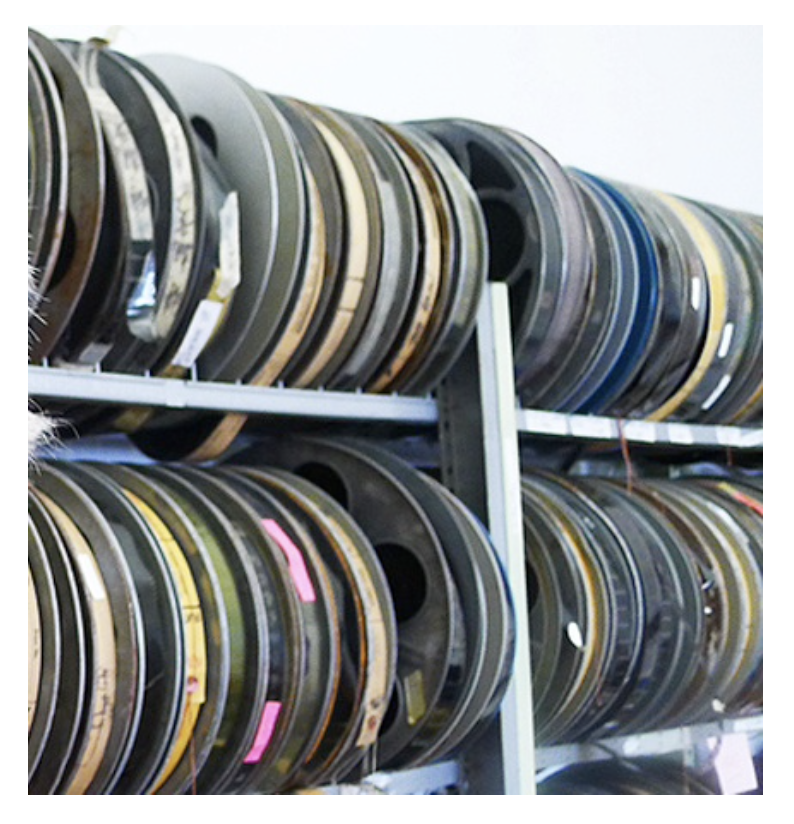
What links this particular set is a combination of factors including, timing, luck and in particular, the passion for Asian film of genre culturalist and film programmer, Colin Geddes. Extensive damage to the emulsion and sprockets of these reels, more usually at the start of the feature or near the final credit rolls, rendered the reels un-projectable. Replacement reels were struck and the discards, detached from their original mission, battle-worn and adrift, joined the shadowy ranks of the redundant and rootless; paper labels, countdown leader grease pencil inscriptions still attached – like stamps in an expired passport – offering a cryptic document of their passage.
Had the pile not been pulled to safety by Geddes the reels would likely have been separated and lost in the great gyre of the internet. As it is this colorful if enfeebled obstinacy has found a landing place and erstwhile permanent residence at LIFT, providing intriguing source material, every pellicule a potential puzzle, for artists and filmmakers passing through on residencies there.
The raft these rolls fell from had itself reached the end of its long journey when they were rescued by Geddes. Toronto was the last stop on the first-run circuit of Hong Kong and Taiwanese action films which played to the Asian diaspora in the city for decades. Since it was too costly to return prints to distributors in Hong Kong, the cans were stored in the basement of Toronto’s Royal Cinemas, formerly the Golden Princess. The Royal eventually closed and the prints were forgotten. Sometime in the early 1990’s, Colin Geddes discovered the trove of whole intact features comprising almost 400 Hong Kong and Taiwanese titles. These “celluloid orphans of international cinema”, as they became known, were the source for his Kung Fu Fridays, a popular screening series he started. After more than a decade of
screenings and a loyal following, Kung Fu Fridays ended and the prints were donated in to the University of Toronto where they are now permanently archived.ii
The orphans of the orphans, meanwhile, ensconced at LIFT are more informally housed. Casually filed and hardly catalogued they have a randomness of content that is endlessly tantalizing for the surprises they offer. Somewhere in the lot, for instance, there may yet turn up a fragment from the vampyric romp, The Haunted Cop Shop, written by Wong Kar Wai., the parent of which, apparently, is locatable among the stacks in the UT archive. iii
In 2008 LIFT commissioned 4 artists to make work using the collection as a source.iv Each of
the artists chosen were connected to the Asian diaspora in Canada by birth or ancestry and used the collection to make work that re-shaped certain forms or particular figures familiar to them in Asian culture. One of the commissioned artists, Montreal-based Japanese filmmaker Daichi Saito, in a thoughtfully considered approach to the mandates of the commission, burrowed into the hundreds of reels, pulling from the pile a single fragment showing a figure walking in a forest, which he then re-photographed altering the timing so that although the figure moved, it seemed to do so in place, wavering between positions. In a play on the explosive kinetic style typical of martial arts films and a nod to Eadward Muybridge’s motion studies, he describes the piece as “an action movie without action . . . . . (the figure is) caught between perpetual motion and stasis” aligning the work more to ideas of pure phenomena than any particular cultural politic.
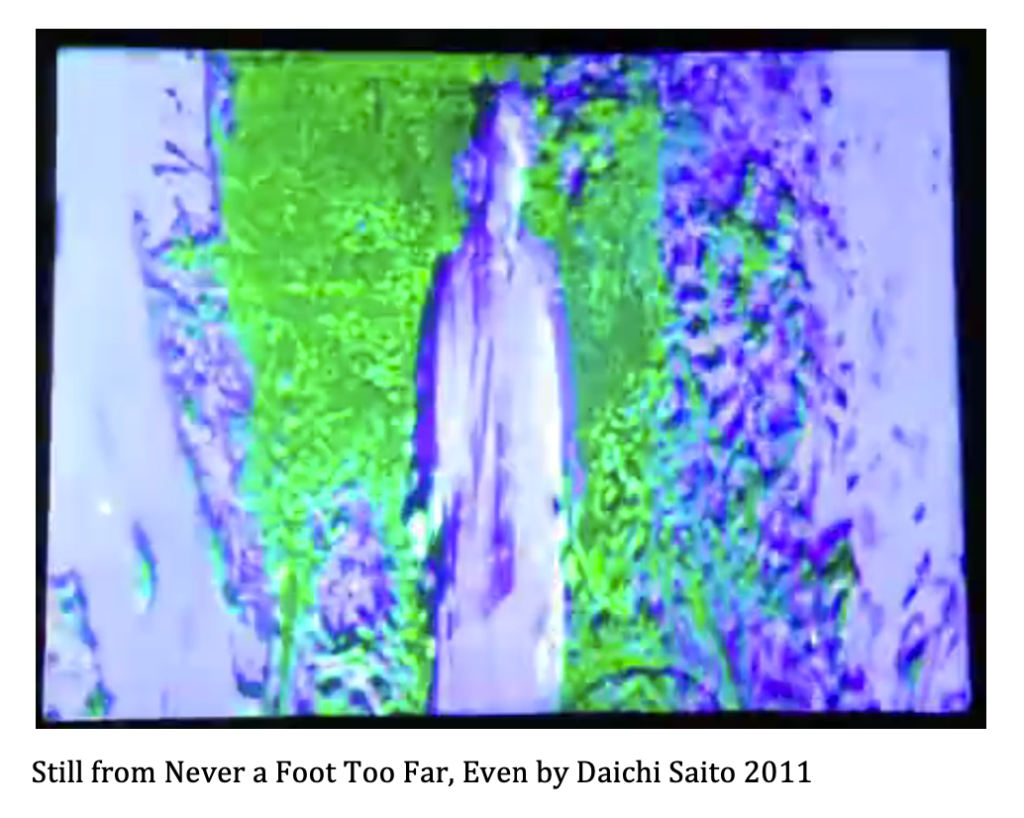
With the use of two 16mm looping projectors, one image is cast on top of the other creating a perceptual depth to the pulsing image which amplifies the stasis/movement dichotomy. His reworking of the original fragment using re-photography and hand processing techniques saturates the film with colors and textured abstract shapes. The intermittent appearance of trees surrounds an ever-shifting center in which the figure walking/not walking is anchored. The work is not dissimilar in technique to that of a number of other experimental filmmakers, past and present, who take a small element as a source for an expanded illumination of an essence of cinema as they see it. However, Never a Foot… differs from other hand processed films, such the painted films of the late Stan Brakhage, where the emphatic texture produced by continuously pulls the eye to an immeasurable constellation of points across the plane, adding film time to the wandering path of looking at a painting, Never a Foot.. holds the eye’s attention at the center and in doing so creates an analog, intentionally or not, for the eye’s own biological structure, favoring as it does, infinite detail at the center and heightened response to movement at the periphery. The pulsing surrounding the figure is enhanced by this biological factor and as the gaze rests on the figure and pulses flow around it, attention alternates between discerning the particulars amid fields of rhythms and pattern. This experience, greatly enhanced by Malcolm Goldstein’s powerful music score, is perhaps closer to a cinema of transcendence, where feedback loops between the viewer and the viewed is a tacit component of the work. Saito draws on Samuel Beckett’s Stirrings Still, in ostensibly situating the philosophy of his intent: “…..was he then now to press on regardless, now in one direction and now in another, or on the other hand stir no more as the case might be ….”.
Never a Foot Too Far, Even , a palindrome, plays out the ambivalent direction of its own name in the projected image. v
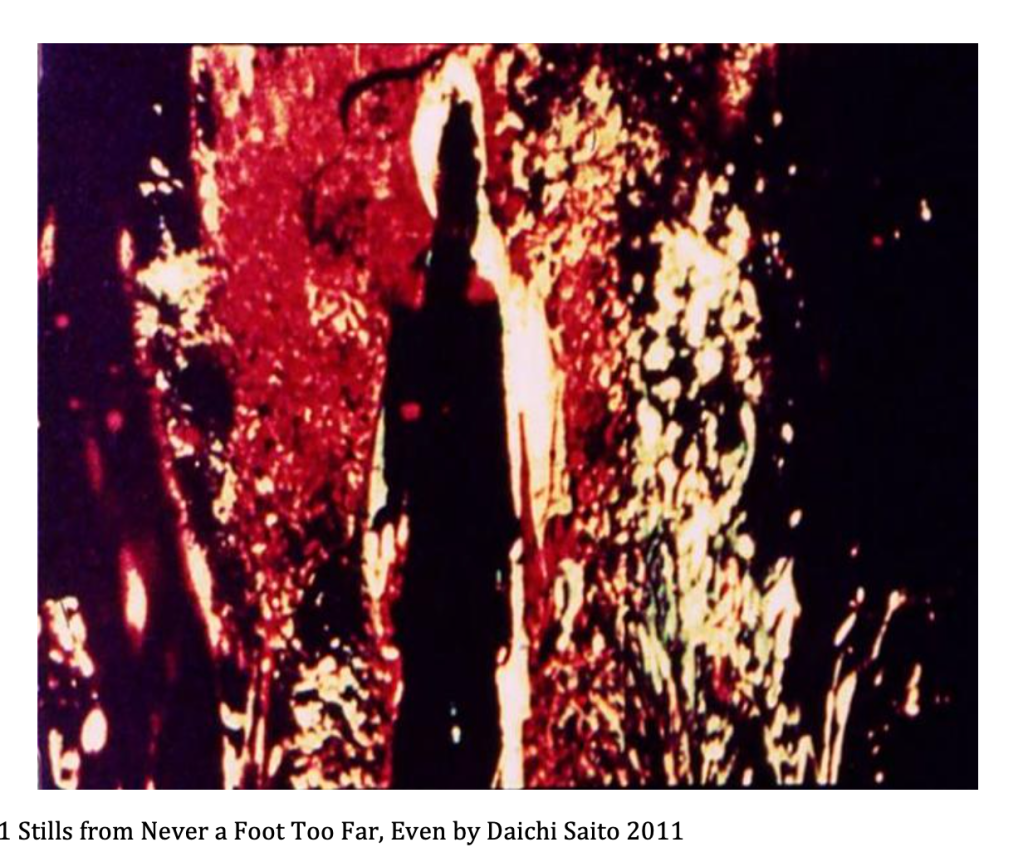
In addition to gallery sites, Saito also screens the work in more conventional theatrical settings as a dual projection, an increasingly common crossover of venues being explored by filmmakers. The cinema setting traditionally directs the viewers attention in one direction only whereas the gallery space, containing both the image-making machines with their own internal lights and amniotic hum and the spectral offspring, weighs one against the other; the human-shaped kinetatron hovering in a continuous resemblance of itself, reflects the mechanical circumstance of its being.
Filmmaker and DJ Ephraim Asili made a work from the collection, happening upon the orphan film reel hoard during his residency at LIFT in 2015. He created a work that similarly charges the image using techniques of re-photography, this time using manipulations of rhythm and sound culled from the image as well as the soundtrack of the original film fragments.
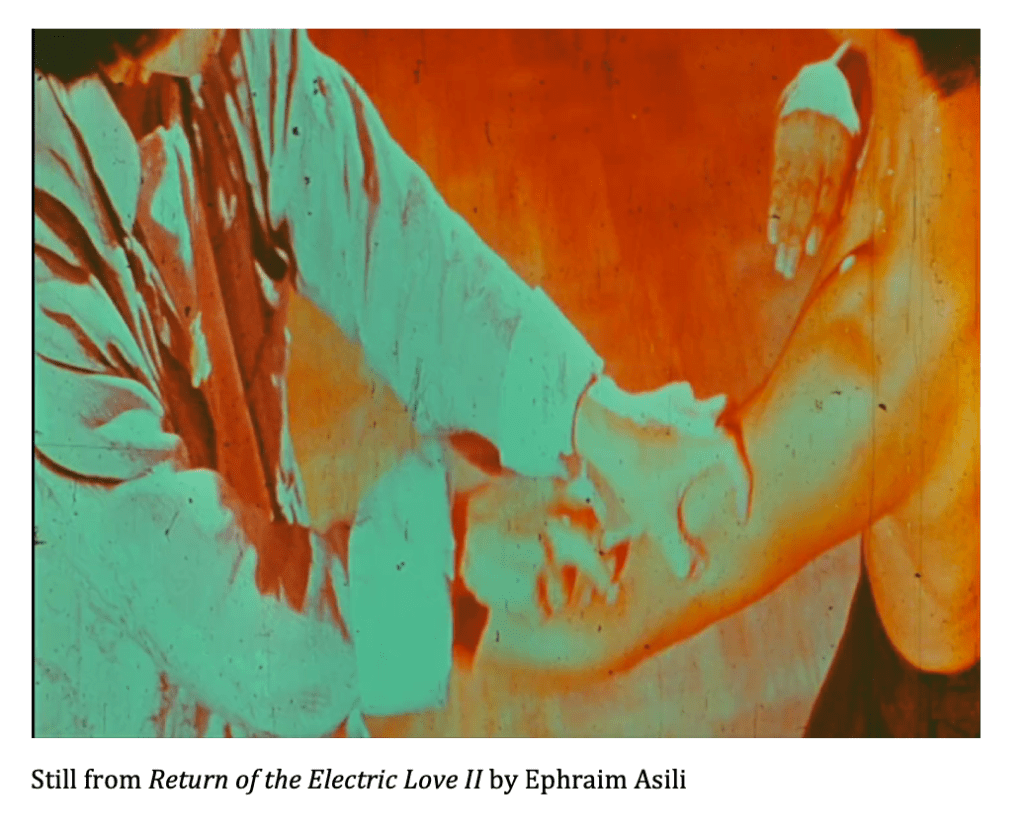
In the 12 minute Return of the Electric Love (Take ll), controlled movement in a frenzy of flickering color frame a series of visual and sound syncopations carried out on short scenes extracted from a number of different Asian film reels. Asili re-photographed the film on an Oxberry animation stand in 35mm, thus preserving the one-to-one scale of the source and capitalizing on the fine resolution of 35mm. Since the Oxberry camera capture the whole width of the film frame which includes the optical soundtrack, Asili was able to generate sounds by photographic means, creating a range of abrasive musical saw tooth tones.vi These notes drill the air with demanding beats and textured pitches in counterpoint to a rheological order of martial arts gestures moving in stepped and freeze frames. He plays the Oxberry as an instrument, construing improvisational patterns and permutations of sequences on the fly.
Two figures in hand to hand combat flailing about in blazing colors are rendered in negative, their white hair feathering in purples, oranges, and shock pinks, their costumed bodies moving in glacial stop-time motion. A graphical synesthesia presides in the work as bright flickering color and strong shapes easily move between traceable image and visual sound, occasionally becoming the dominant music of the piece, all combining to complicate the cadential pattern of the work. A larger imprint of a kind of filmic ragtime overlays the piece in the simultaneously buoyant dances and stop time motion of the Kung Fu characters in the frame. This is a work at exuberant play and offers a energetic Dervish to the transcendent timing of Saito’s double-projection piece.
–
This collection of found footage film reels are endlessly engaging to explore. Extravagantly
gestural martial arts body-moves, already well fitted to the bounded illusory space of cinema define a tight geometry on a two-dimensional plane while stirring imaginative spatial phenomena in a fictional third. Maya Deren’s, Meditations on Violence from 1945 is an example of a tightly structured interaction between the medium and subject. Tension is maintained between the orientation of the camera and the performer, Chao-li Chi,
throughout. Cutting in the middle of continuous movement enables transfigured locations, connecting white background, black background and exterior locations without breaking continuity. In some shots the performer faces forward in direct confrontational stance with the camera, holding a gaze making swift movements forwards and backwards along the z axis. The action begins slowly, quickening at the middle with freeze-frames and slow motion shots at various points throughout .vii
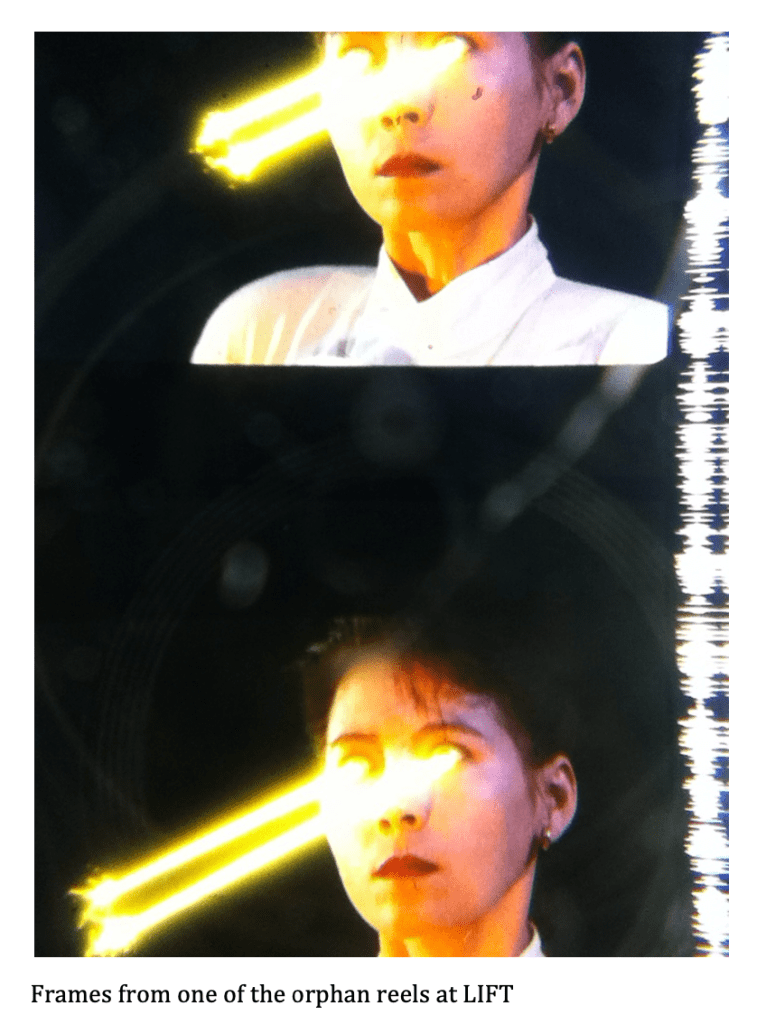
Geared for entertainment, Kung Fu action features make liberal use of the shock zoom as it’s own dramatic signifier. It can denote emotional exclamation, sudden plot twist, or a routine break in the space/time continuum, a portal into the spirit world, the inhabitants of which appearing as luck, or bad fate personified, or raw energy beamed straight out of the eyes of a human in a devastating blast of power.
Not only does the material object of film deteriorate with age and handling but its
content; story, color palette and style, also undergoes a continuous perceptual revolution, beginning perhaps with its final run in the last cinema on the outskirts of town where the images must be discerned through a hail of scratches and crackling sound. Seeing a print on
its last legs in a hinterland cinema comes with the feeling of having missed the bus pleasantly offset by a sensation of being suspended indefinitely in a time out of mind. Like most cultural artifacts a film, already past its first run and entering an uncertain future, sinks and rises again in the heaving tidal unconscious of collective regard. Under sail on the pirated waters of opportunistic economics the film disappears for long periods, emerging again sometimes only to be caught in the anthropogenic whirlpool of suffocating nostalgia. There it turns in and out of view in endless reruns until finally it disappears into the merciful vortex. Decades pass before its wounded body beaches on some resale table on the far side of the continent. A film found in this condition, abjectly abandoned, released of all claims, in it’s last gasp, is a chrysalis, a new entity in the making. As an artist instinctively tuned to the murmurs of discarded things, I connect with abandoned film in an elemental way, its reduced circumstance also reflects shared unspoken anxieties. Abiding in its new fate we whistle the same song in the dark.
The general rarity of found film in current times presents a novel and critical challenge when, having found a gem, the practicing found footage-ist is confronted with a dilemma; to cut or not to cut. No longer bound by analog constraints the time honored process of frame by frame photographic reproduction – once a necessity, is now one of a number of ostensible options. Old boundaries are vaporized and the film material is opened to the elements in the digital blender to be reshaped into any number of alternative cinematic forms, whilst preserving intact the original film itself.
An essential component of transubstantiation, the erstwhile destruction of the original in the process of being reformed, is displaced, if not outright lost and consequently the digitized frames cannot be but perceived in a way that has fundamentally changed forever. Audience and artist alike are realized to the limitless non-destructive dispersal of infinitely malleable digital packets. What used to be a primary act of intrusion upon the found film, an intrusion with consequences, a knife to the emulsion, has become part of the rhetorical lexicon of film in the digital world, inescapably viewed through the lens of ubiquitous digital optimization.
The collateral erasure of pathways and points on the analog map have guided my approach in working with found footage film in a digital environment over the last few years. Thoughts on the properties of the medium; its chemical sensitivity to light, intermittent mechanism of camera and projector, the frames-per-second standard, inform the experiment in End Reel (2013) and Untitled (earth) (2015), two short digital pieces that clinch their conceptual coherence in the inter-dependence between the two mediums.
Winding the large 35mm film reels over the light box on the film table is a palpably hypnotic process offering suggestive and ambiguous hints of plot in the random stop/start motion. The narrative can be figured out in the frames periodically paused upon in the winding process. Viewing film this way is a event onto itself, different from viewing on a flatbed, for example, so that the whole film, its image and object, is found, allowing a broader interpretation of the subgenre.
In End Reel (2013), a 7 minute edit made using the final reel from a 35mm Hong Kong action feature, The Green Hornet, which in a continuous 22 minute take, was examined as described above over a light-box on a well worn editing bench using hand-cranked rewinds to pull the film back and forth. In a speculative act of looking the film is wound forward in stops and starts with no particular conscious aim for when or where pauses occur. Pausing on this or that frame, every new image is an unpredictable surprise, with the film then blurring again as it continues along its passage.
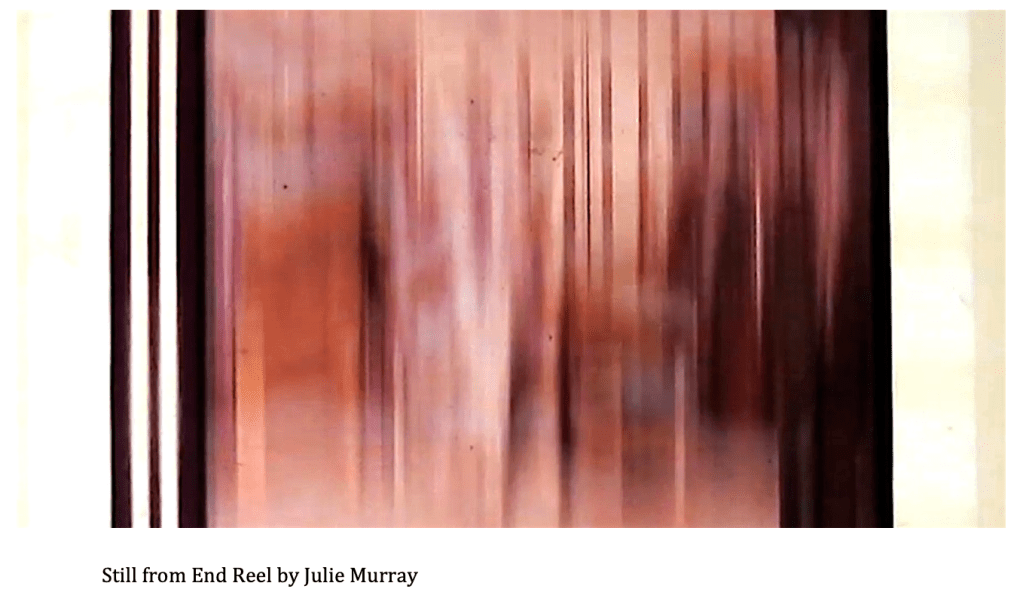
The break the continuity of the plot per original offers hints at the threads of the narrative as originally intended. The mind compulsively assembles plausible rationales to fill in the gaps, or drifts obliviously on the soft rhythms of the abstraction. By not cutting the film on the frames or sequences of frames emphasis remains on performance of looking in real time as blur blends with stops and variations emerge on slow or fast winds.
No action of start/stop can be replicated exactly. If during the winding a particular section stands out, it is impossible to go back and perform exactly the same roll-through the same way again. The speed, always varying, never quite matches and the effect is gone. Curiously, the result of attempts to do so produces a perceptible self consciousness; the engagement of
looking becoming studied and laborious. It seems to suffer a similar drain of energy that improvised music does if scored note for note. Having any adjudicating thoughts while engaged in the process of looking and winding also interrupts the energy and pulse, necessitating a start over. The breaking of concentration in the act of looking effectively breaks a bond and ends the process. It lives only in the momentum of continual emergence outside the consciousness of ‘before’ and ‘after’.
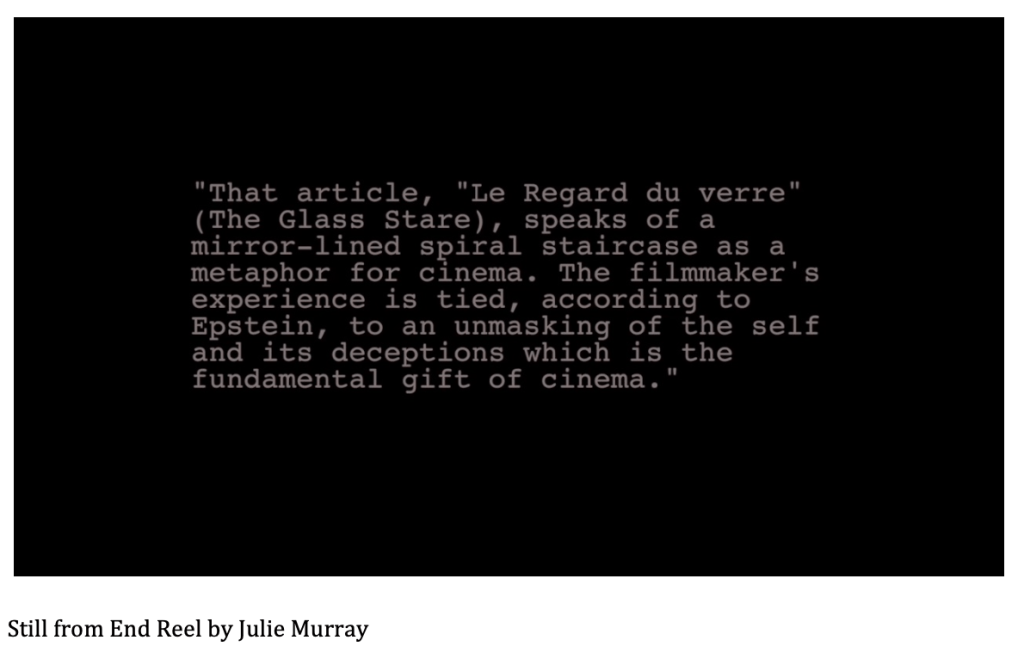
End Reel opens on a quote quoting; a textual graphic of nested referents contained in an inter-title, suggesting in word form a parallel in the multiplicity of influences and shared ideas at play. A found footage montage brings with it a host of shadows and echoes of the source material’s cultural past which becomes an intrinsic part of the work. The text is by P. Adam Sitney who is citing Jean Epstein, who in 1923 laid out the mysterious properties of cinema’s “photogenie”, the clairvoyant power innate to the cinematic form, as he saw it. His excitement for the impartial eye of the camera is today darkly echoed in the ubiquitous presence of surveillance cameras everywhere. The emphasizes the video camera’s role in End Reel as a device of objective record, impassive and impartial, reflects this, containing both a degree of menace and reassurance in its unblinking gaze. Implied is that the cinematic image by reason of its objectivity shows the thing photographed for what it really is. In her introduction to Jean Epstein: Critical Essays and New Translations viii , Sarah Keller states, “Visuality is indeed the foundation upon which Epstein’s concept and practice of cinema rests: photogénie lays bare the nature of the object as photographed; it helps us to see in a way we haven’t seen before.”
Consider this in regard, also, to the twist on the “photogenie” of facial recognition capabilities broadly in service in the current social environment and its helpfulness is certainly to be questioned at a root level. Keller quotes Epstein, who writes, “The camera lens…is an eye endowed with nonhuman analytical properties. It is an eye without prejudices, without morality, free of influences; and it sees in the face and in human movement traits which we, weighted down by likings and dislikings, by habits and considerations, can no longer perceive.”
The objectivity of the camera eye in the evolved camera of today might just as well inspire fear and dread, as enthusiasm. Intrusions already upon human freedom and autonomy currently expressed in cautionary editorials by scientists, theorists, economists and those working in the development of AI (in which the role of image is a critical and indispensable component), seem to appear in nascent form in Epstein’s words.
The mirror lined spiral staircase evoked by Epstein is a particularly potent form, reflecting as it would a blizzard of shifting faceted images back upon the subject. While its kinship with cubism in turn of the 20th century painting and a shared curiosity for the philosophical and metaphysics of the time was clearly the driver of Epstein’s enthusiasm, it is still peculiar to experience an interpretation at such stark variance to what Epstein saw as a favorably powerful attribute of the cinematic mechanized eye.
The winding of the film reel was recorded, as noted above, in a single continuous take in digital video capture using a Canon pocket camera positioned above the film as it passed over a light box. The video image, running bottom to top, blurs as it is pulled and slipping in and out of phase with the video frame rate, appears sometimes to drift up and then down, while the action, such as it can be discerned, is consistently moving forwards along it’s original plot line. The video camera also generates its own litany of artifacts. A pulsing focus and uncertain coherence of action appears and disappears as its own frame rate falls in and out of sync with the rate of winding, differing again on the sides of the screen as the sprocket holes establish a rhythm of ascent and descent independent of the other two apparent motions. The dissolution of the image under these circumstances speaks directly to a pall of anxious skepticism attending images in today’s world. Gestures and body movements are quite readable in the blur and even emotional dispositions come through without the need for clearly resolved facial features.
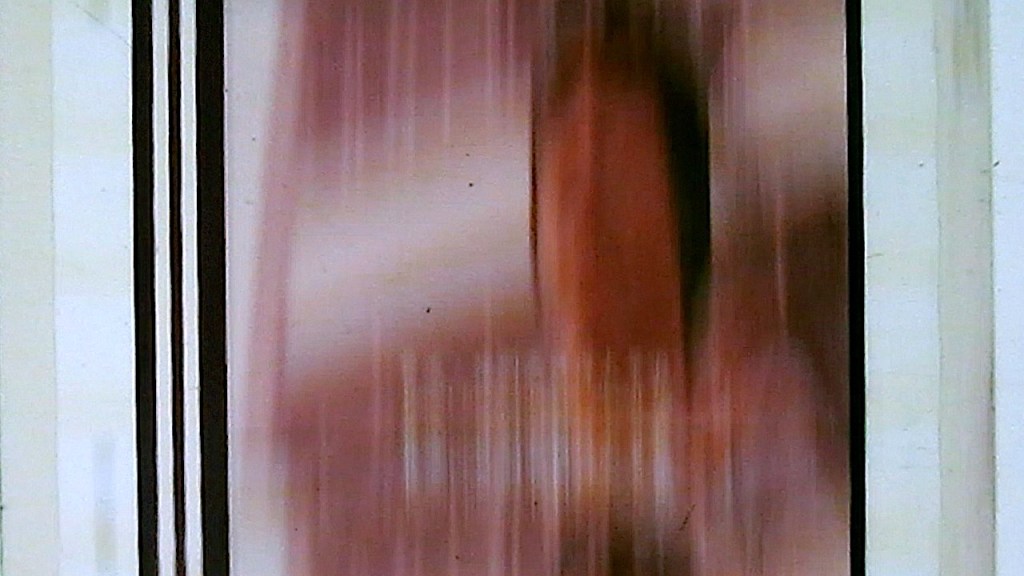
If all this can be so readily discerned in the blur then where does the image happen? In the memory of all images seen before? Or in the volumes contained in subtle gestures of the human body, readable as a book. The lack of sharpness and resolved detail frees the mind of the viewer to wander more imaginatively, re-situating the filmic event somewhere in the space between the viewer and the screen. The image in this case, the shadow cast on the screen, is but a catalyst.
The pairing of film and video as a duet of interaction between analog and electronic motion in a hands-off -minds-on intervention while directly engaging the physical material, acknowledges an unfinished passage of the found film object, anticipating future continuities within the archive. Another artist may have ideas for the same images and take them as their source.
Such decentralization of perspective where the found footage agent, interventionist, artist plays but an interim role, mirrors current inquiries on the question of what defines “cinema” in our digital age as film finds its virtualized body dispersed over immeasurable distances simultaneously in algorithmic abstractions that have nothing to do with the indelible imprint of light on chemically sensitive film which for a century defined the form.
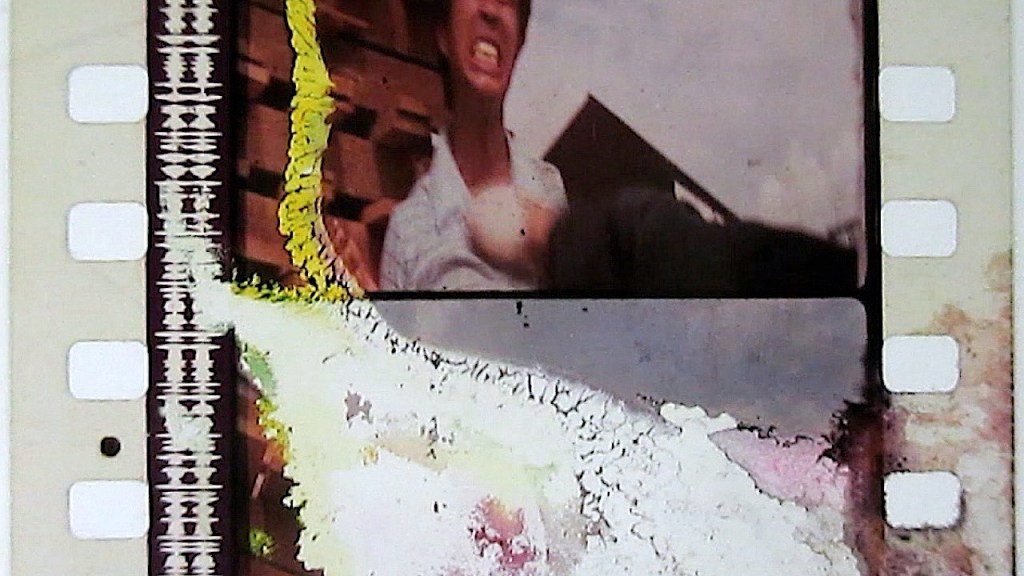
The thoughts laid out above are wordlessly infused in the process of making this series. In the now unbelievable world of apparent motion, this plying of poetic-on-document is at the heart of the rationale that guides End Reel (2013). No film image/frame is simple or plain. The charge it gives off is the accumulated energy of a flood of memories real and dreamed up. Texture, tone and content all conspire so that the material frame itself is but a catalyst for experiences born almost completely in the mind. The predominant external experience, flickering on the screen, is one of visual abstraction forming in bands of modulated frequencies in color, light and shadow play, creating a duet with the body’s own waves. Film is plasma for the heart of the matter whose mortally affected soul nevertheless lives on in the new prismatic shadows of a digitally silvered light.
Julie Murray 2017
Special thanks to LIFT director, Chris Kennedy for providing links and details on the orphan collection.
i Liaison of Independent Filmmakers, Toronto Ontario.
ii Sharing a Hong Kong Treasure Trove by Eric Veillette, Toronto Star April 12 2010
iii Kung Fu Fridays: Reel Asian: Asian Canada on Screen – Elaine Chang, ed., Coach House Books; Oct. 2004
iv Lost Secrets of the Royal curated by Liaison of Independent Filmmakers then director Ben Donoghue and Heather Keung, Toronto Ontario.
v Conversations with the artist, Daichi Saito.
vi Conversation with the artist, Ephraim Asili.
vii YouTube link to Maya Deren’s Meditation on Violence (1945)
viii Jean Epstein Critical Essays and New Translations Edited by
Sarah Keller & Jason N. Paul , Amsterdam University Press, 2012
